Dana Braun · 21 September 2026
Tracing Connections Between Memorial Groves and Shifts in Local Allergy Patterns Through Long-Term Pollen Data
Memorial groves planted across North America and parts of Europe have provided researchers with unique opportunities to examine how concentrated tree populations influence airborne pollen levels over extended periods, and long-term data sets now allow direct comparisons between grove establishment dates and subsequent changes in regional allergy reports. These groves, often dedicated to historical figures or community events, typically feature dense clusters of species such as oaks, maples, and birches that release substantial quantities of pollen during spring and early summer months.
Establishment of Memorial Groves and Initial Pollen Monitoring
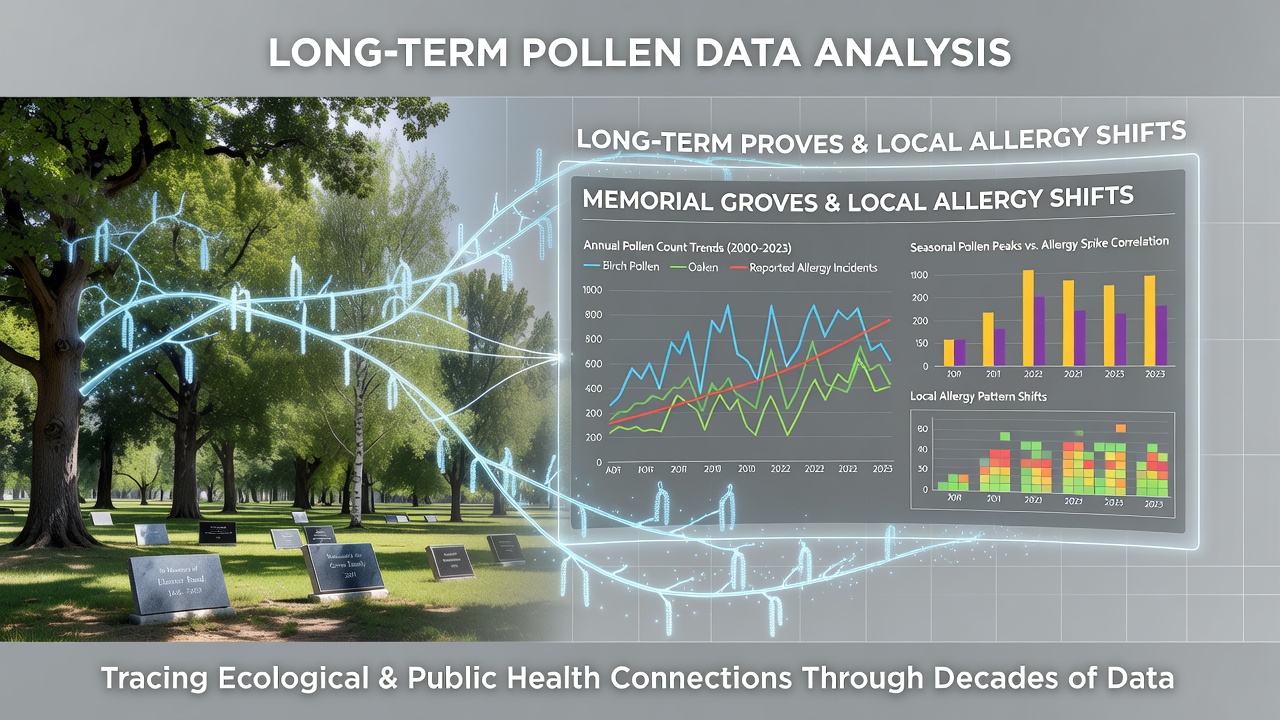
Communities began establishing memorial groves in the early twentieth century, yet systematic pollen tracking only gained momentum after the 1970s when standardized collection methods became widespread. Stations placed near grove boundaries record daily particle counts, and records from these instruments reveal that areas surrounding newer groves frequently register higher seasonal totals compared with nearby sites lacking concentrated plantings. Data collected through 2025 shows consistent patterns where oak-dominated groves contribute measurable spikes in coarse particulate matter during peak release windows.
Observers note that grove density plays a central role because closely spaced trees increase overall pollen output while also sheltering particles from wind dispersal, which can prolong local exposure times. In one documented case, a grove dedicated in 1998 near a midwestern university campus coincided with a documented rise in allergy-related clinic visits within a two-kilometer radius over the following decade.
Long-Term Data Analysis Techniques
Analysts combine historical pollen archives with satellite imagery and land-use records to isolate the contribution of memorial groves from broader climate influences. Regression models applied to multi-decade data sets indicate that the addition of several hundred mature trees within a confined area can elevate local pollen concentrations by measurable percentages during specific weeks, although effects diminish with distance from the grove perimeter. September 2026 updates to several North American monitoring networks incorporated refined particle-size fractionation methods that further clarify how grove species composition affects different allergen profiles.
Regional Variations in Recorded Shifts
Western groves planted with drought-tolerant oaks display different seasonal curves than their eastern counterparts, where higher humidity extends pollen viability. Data from Australian monitoring programs, coordinated through the Australian Department of the Environment, demonstrate parallel trends in eucalyptus memorial plantings, although direct species comparisons remain limited. European networks have similarly tracked beech and lime groves, confirming that localized increases appear most pronounced within the first fifteen years after planting when trees reach full reproductive maturity.

Integration with Public Health Records
Health departments in multiple jurisdictions now cross-reference pollen databases with de-identified patient data to identify correlations between grove proximity and reported symptoms. Figures from the National Institute of Allergy and Infectious Diseases archives illustrate that certain zip codes containing memorial groves show elevated prescription rates for antihistamines during spring quarters, yet causation remains difficult to isolate from confounding variables such as urban expansion and changing weather patterns. Researchers continue to refine spatial mapping tools that overlay grove boundaries with health-service utilization zones.
Monitoring programs have expanded in recent years to include mobile sensors that capture vertical pollen gradients inside groves themselves, revealing that concentrations can reach several times the levels recorded at standard rooftop stations. These findings help explain why residents living immediately adjacent to grove sites sometimes report more intense symptoms than those farther away, even when regional forecasts suggest moderate conditions.
Future Monitoring Directions
Updated protocols scheduled for implementation after September 2026 emphasize automated image analysis of pollen grains to distinguish species contributions more precisely, which should strengthen statistical links between specific memorial plantings and local exposure profiles. Continued collection at fixed sites will allow models to project how maturing groves might alter patterns over the next several decades as climate conditions continue to evolve.
Conclusion
Long-term pollen records paired with detailed grove histories demonstrate measurable connections between concentrated memorial plantings and localized shifts in allergy-related indicators, and ongoing refinements in data collection promise clearer insights into these relationships across diverse geographic regions.